
Managing the expenses and family budget during the school year is always a challenge with lots of unexpected costs. How can parents prepare better for the school year? What are some useful resources parents can rely on? We’ve sat with Holly Andrews, a director at KIS Finance, who shared some of the tips and tricks with our readers.
When parents think about back-to-school expenses, they usually focus on uniforms and stationery. What are some of the ‘hidden’ or unexpected costs that tend to surprise families throughout the school year?
The start of a new school year can cause additional strain on the family budget. With new uniforms, shoes, bags and stationery often have to be bought within a few weeks of each other, just as many households are still recovering from the cost of the summer holidays.
September and the start of the school year is only the beginning!
Unfortunately, school spending rarely arrives as one clear annual bill. Instead, it turns up regularly through a series of emails, app notifications and letters home, often with a short payment deadline.
The school costs parents do not always see coming
When people think about back-to-school expenses, they will usually first think of uniforms, shoes, raincoats, lunchboxes and stationery.
The less visible costs appear gradually over the school year.
They may be deposits for residential trips, contributions towards day trips, school photographs, yearbooks, non-uniform days, Christmas fairs, class collections, leavers’ hoodies, prom clothes and end-of-term gifts.
Then there are the everyday surprises. Children lose water bottles, grow out of shoes sooner than expected, damage bags and misplace PE kit. A winter coat may need replacing halfway through the year, while a sudden growth spurt can make a recently purchased uniform quickly unusable.
Social costs can also add up. Birthday parties may mean buying presents several times a term. Older children may want money for school events, for food with friends or additional travel costs. Each request may often appear to be modest, but the annual total when added up, can be significant.
Extra-curricular activities often have other additional expenses that are not immediately apparent on their own. For example the advertised price of football, dance or music lessons may not include kit, instruments, exam fees, competitions, performances or travel.
Childcare is another major cost for the families. Half terms, school holidays, teacher-training days and occasional early finishes can all create additional expense for working parents.
All these extra costs can make a serious unexpected dent in the household budget.
How can parents audit these hidden costs early in the term so they aren’t caught off guard?
Start with all available information and from this create a school-year spending calendar.
Review school apps, emails, letters which inform of any planned events throughout the year, for example, trip deposits, sport fees, etc.
Parents may notice, for example, that a trip deposit is requested in September, photographs are offered in October and sports fees are due in January.
| Term / Month | Key Events & Necessities | Estimated Budget (£) | Notes / Planning Considerations |
|---|---|---|---|
| September (Start of Autumn Term) | Uniform refresh, stationery, PE kit, school shoes, lunch account top-up | 150–250 | Biggest spend of the year; check second-hand uniform sales. |
| October | School photos, autumn trips, Halloween activities | 20–60 | Photos often optional; trips vary by school. |
| November | After-school clubs, winter coat, revision guides | 40–120 | Some clubs run termly; consider reusable resources. |
| December | Christmas events, charity donations, class parties | 10–40 | Keep small buffer for last-minute contributions. |
| January (Start of Spring Term) | New term supplies, replacement uniform items | 20–60 | Good time to buy discounted stationery. |
| February | School trip deposits, World Book Day costume | 10–50 | DIY costumes can reduce costs. |
| March | Parent evenings, exam prep materials | 10–30 | Mostly low-cost unless buying revision books. |
| April (Start of Summer Term) | Summer uniform items, sports day prep | 20–80 | Check if last year’s items still fit. |
| May | Exam fees (if applicable), school photos (summer), clubs | 20–60 | Secondary schools may have additional costs. |
| June | End-of-year trips, performance outfits (e.g., Stagecoach) | 30–120 | Trips often higher cost; plan ahead. |
| July | Teacher gifts, leavers’ events, summer activities | 10–40 | Optional but common. |
| August (Holiday Period) | Holiday clubs, back-to-school prep begins | 50–150 | Spread uniform costs across August & September. |
What is a practical, flexible framework you recommend for family budgeting during the school term?
A practical way to organise school spending is to divide it into four pots.
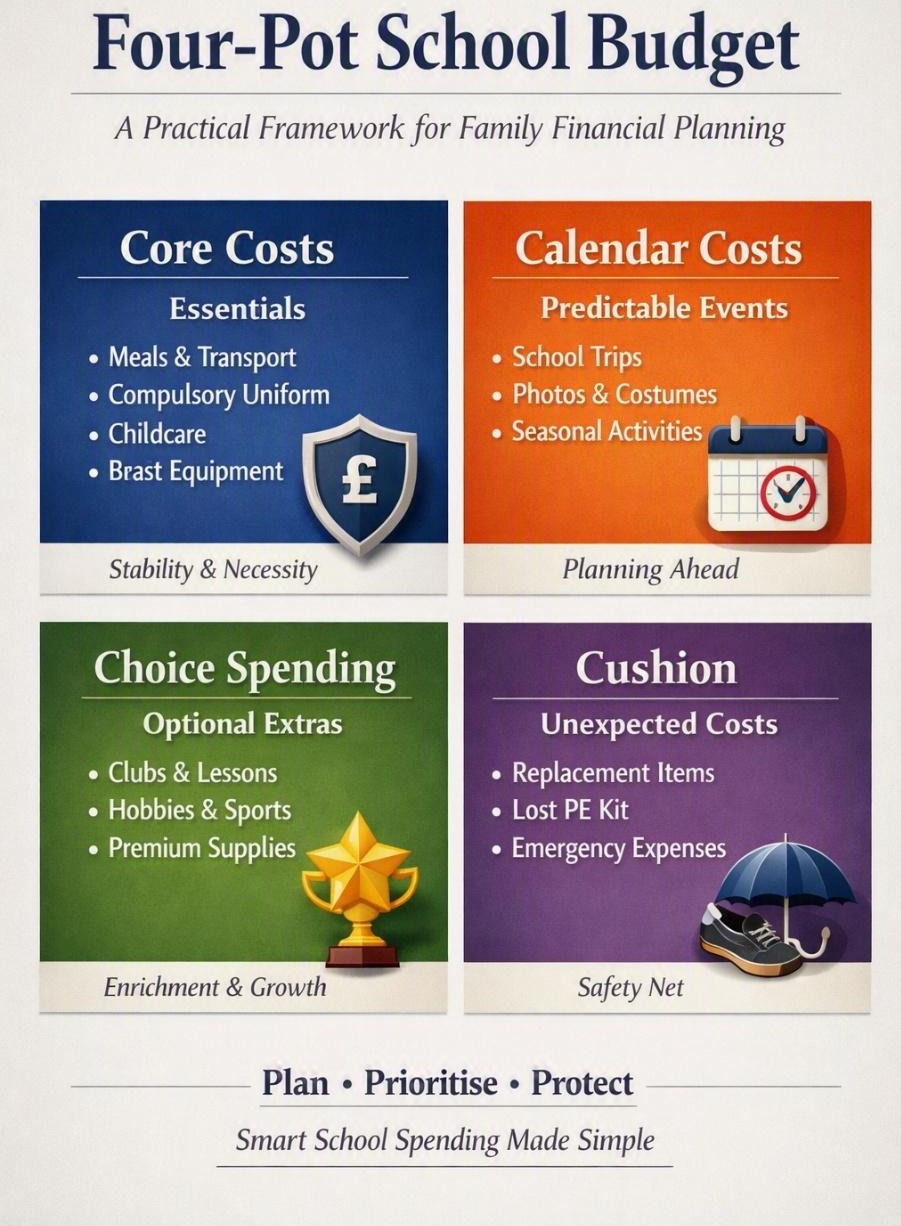
Core costs should be protected first. Parents can then set aside money for known calendar expenses, then decide what is affordable for the optional activities.
These pots do not need to be separate bank accounts. They could be categories in a budgeting app (see useful resources at the end of the article), spreadsheet headings or labelled savings pots within online banking.
The important point that you will find helpful, is that school money is visible rather than disappearing into the general household balance.
Extra-curricular activities like music lessons or football clubs can easily add up to hundreds of pounds a term. How can parents balance supporting their children’s passions without overstretching their household budget?
Parents will always want to support their children’s interests. Therefore it is difficult to not say yes to additional activities such as music, sport and drama, that can help young people develop new skills, grow in confidence and form friendships.
Unfortunately, the additional costs associated with extra-curricular activities, can quickly add up to several hundred pounds each term, especially for larger families with more children wanting to participate in these additional activities.
Before signing up, be careful to calculate the full cost of the activity, rather than just looking at the monthly or weekly fee. Remember to take account of and factor in items such as any equipment, clothing, travel, exams, competitions and any annual membership charges. A lesson costing £15 a week may seem affordable, but over a year it becomes a far larger commitment, even before any extras are also included.
Always make use of trial sessions, as these can help families avoid paying for a full term and buying kit only to discover that the child does not enjoy the activity.
School-based clubs, community groups, sharing transport with friends and neighbours, equipment rental, and second-hand items can all help keep costs down.
What’s your advice for parents who feel ‘peer pressure’ or guilt when they see other families funding multiple premium clubs?
School life can unfortunately create a lot of financial comparisons. It’s easy for parents to notice other children attending multiple premium clubs, carrying expensive bags or signing up for every optional trip. This can lead to guilt, or worrying that saying no means holding a child back.
In reality, families rarely know the full circumstances behind what they see. Another household may have a higher income, support from grandparents or fewer financial commitments. Equally, some spending may be funded through credit cards or loans, so may not be as comfortable as it appears.
Making choices and being able to plan ahead is also an important life lesson for children. Instead of saying, “We can’t afford something,” a parent could say, “We have room in our budget for one activity, so let’s choose the one you’d enjoy the most.”
This can give a child a sense of involvement without placing the weight of the family’s finances on their shoulders. Setting a sensible limit is not letting a child down, instead it is modelling responsible behaviour that is a useful life lesson.
What are the common school-year budgeting mistakes
The first common mistake is budgeting only for September. Although uniforms and stationery may be the most obvious purchases, school costs continue throughout the remaining school year. Families therefore need a school-year budget, not just a back-to-school shopping list.
A further mistake commonly made is looking at the advertised price rather than the cost of the total commitment. This is particularly common with clubs and lessons. Parents should calculate the annual cost and include the associated extras before agreeing.
Another is leaving no room for the unexpected. A budget that has no contingency and uses every available pound, can be quickly disrupted by broken equipment or an unplanned event.
A surprising but easy common mistake is that it is easy to continue paying for things that are no longer used. An activity may have been worthwhile in September, but by February it is no longer useful or even becomes a chore. Reviewing commitments at the end of each half term can release money for more important priorities or a new activity.
Finally, some families miss out on financial help because they assume it will be offered automatically, don’t know help exists or are afraid or embarrassed to ask. Depending on where they live and their circumstances, support may be available with school meals, uniform, transport, childcare, trips or post-16 education. Parents who are struggling should check with the school, local council and the relevant government service. Some support requires a separate application, even where the child already receives another benefit or a universal free meal.
Schools may also have second-hand uniform schemes available, along with hardship funds, payment plans and discretionary help for school trips.
At what age should children start taking financial responsibility for their own extra activities or non-essential school items?
Children can begin learning about financial choices during primary school. At around seven or eight year old, this, for example, might involve choosing between two non-essential items or deciding how to use a small amount of pocket money.
By secondary-school age, many children can manage a modest allowance for snacks, social spending or optional stationery. This gives them experience of deciding what matters most and understanding how money that is spent in one place is no longer available to spend again elsewhere.
Older children, teenagers, may be able to contribute towards upgrades, expensive hobbies or additional activities using pocket money or gifts.
Making the distinction between essential and optional spending is very important. The goal here is to build confidence and good habits, but not to make a child feel guilty about the household budget. Children can still be healthily involved in making choices, without being burdened with adult worries.
Review the budget every half term
It is close to impossible for a family to predict the entire school year budget perfectly in September, so it is important that the budget should be treated as a working plan rather than something that is fixed and written in stone.
At the end of each half term update your budget. Have a look at what cost more than expected, which expenses were completely forgotten, and whether or not any clubs or subscriptions are no longer being used or are about to change. Check the next part of the school calendar to see what lies ahead and make adjustments where necessary.
This is especially useful before expensive periods such as Christmas, residential-trip season, exam time and the summer holidays, and will help with planning other household budgets.
The first school year is the trickiest. After one complete school year, families will have a much more accurate picture of what school really costs them, making the next year easier to plan for.
Budget for the whole school year, not just the first week of September.
This is probably the best single rule for controlling school costs.
Before agreeing to a regular activity or optional purchase, calculate what it will cost over the full year, including all the associated extras, and then decide where that money will come from and if you can afford it.
A useful school budget does not have to account for every penny. It needs to simply make the likely costs easily visible, highlight the essentials, and leave enough flexibility for real family life and options.
For parents who are already feeling stretched, this sense of control can be just as valuable as any money saved.
Useful resources that can be used when creating a budget
Here’s a table of free, ad-free budgeting apps you can use for planning the school year.
| App | Best For | Why It Works for School-Year Budgeting |
|---|---|---|
| GnuCash | Detailed budgeting & yearly planning | Lets you create categories for uniform, trips, lunches, clubs; strong reporting. |
| HomeBank | Simple, visual budgeting | Easy to track monthly/term expenses; colourful charts help spot overspending. |
| Money Manager Ex | Quick, straightforward tracking | Great for parents who want simple term-by-term or monthly budgeting. |
| Firefly III | Advanced budgeting & analytics | Ideal for detailed planning, savings goals (e.g., trips), and long-term tracking. |
You can also raise additional money by using dedicated, private and free contribution platforms, allowing family and friends to donate towards holidays, hobbies or birthdays instead of buying physical gifts, as shown in the options listed in the table below:
| Platform | Best For | Description (Detailed) | Visual Style | Ideal Scenario |
|---|---|---|---|---|
| Monzo Shared Pots | Holidays, trips, ongoing hobby costs | Create a named savings pot (e.g., Holiday Fund, Dance Lessons). Share a secure link with family who can contribute directly. Completely private, no adverts, no fees. Great for long-term saving and predictable contributions. | Simple, clean | Families who want a secure, ongoing savings pot for holidays or hobbies. |
| PayPal Money Pools | Birthday/Christmas money instead of gifts | Set up a shared “pool” and send the link to relatives. Very familiar for older family members. No adverts, no fees, no app downloads needed. Best for short-term events. | Basic | Quick birthday or Christmas contributions without needing new apps. |
| GiftRound | Group gifting (birthdays, teacher gifts, family events) | A simple platform where multiple people contribute to one shared pot. No adverts, no fees, no accounts needed for contributors. Works well for one-off events. | Simple | When several relatives want to contribute together to one birthday or event fund. |
| GoHenry Giftlinks | Child budgeting, birthday money | If your child uses GoHenry, relatives can send money directly to their account via a secure link. Helps children learn budgeting and track their own savings. No adverts, no fees. | Child-friendly | Families who want contributions to go straight to the child and support financial learning. |
| HyperJar | Holiday funds, hobby equipment, experience gifts | Create named “Jars” for specific goals (e.g., Football Boots Jar, Holiday Jar). Share with family for contributions. Free, ad-free, and offers visual goal tracking. | Visual, colourful | Families who want clear visual progress towards holiday or hobby goals. |




7 Responses
I think this is a really relevant topic, especially with how much pressure families can face around school expenses. It’s easy to feel like you have to keep up with what other parents are spending, even when it doesn’t fit your budget. Planning ahead and being realistic about what you can afford can make a big difference. I also like the focus on having honest conversations about money rather than letting peer pressure influence every decision.
This really resonated with me. With three kids in school I have felt that pressure to keep up, and honestly the class group chats can turn into a competition over who has the best supplies. My youngest has even started using a low quality meme maker at home to poke fun at our grocery list, which says a lot about how creative kids get when money is tight. Talking to other parents openly about budgets has been the biggest relief. Thanks for sharing this.
Really useful read – the peer pressure angle is the part most money advice skips. We started a simple school-year budget with our kids and talked openly about what we can and can not do, and it made those “everyone else has one” moments much easier to handle. The same trick even works for screen time: a quick round of drive mad together on a rainy afternoon has become our low-cost reward instead of another impulse buy. Thanks for the honest interview.
This interview really resonates. School expenses can feel like a competition and it is easy to overspend just to keep up with friends. Setting a simple weekly budget and planning free breaks has helped me a lot. Even a quick browser game like Summer Rider makes a nice no cost way to switch off between revision sessions. Thanks for the honest tips.
Thanks for this honest interview. Managing school costs is such a real challenge, and I love the idea of small rewards to keep kids motivated. We usually let our kids unwind with a quick round of 2v2 io unblocked games after homework as a treat that does not cost anything. Finding free activities like that really helps the budget. Great tips, thank you!
Really useful interview. The peer pressure angle is something a lot of parents underestimate, and it is good to hear Holly break it down so honestly. We have found that letting kids have some low-cost downtime of their own makes the money conversations far less fraught, and mine have been happily absorbed in sled rider lately. Thanks for sharing these tips.
Adding to this: the same logic applies slightly differently at small scale.